The Divine Cycle
The dominant religion on the Moss-Wren Isles is the Divine Cycle, a tight pantheon that started from the halfling creation myth. It’s composed of five deities: two major and three intermediate (the Way Gods). Followers of the Divine Cycle are polytheistic, worshipping all five gods, but emphasising one Way over the other two (to have a triad they follow). Each of the major deities has three “faces” that represent different aspects of them!
Rhialis
Portfolio
Birth and creation
Industry and war
Associations
Fire, Steel, Blood
Domains
Forge, Life, Light, War
Rhialis embodies the violence and effort of birth and creation, and she is associated with ownership, claim, or possession of something. Rhialis fuelled the creation of the earth with her fire and iron, wrapping the fire that would become the planet in the iron of her forge and seeking to create life on its surface. Her three faces are the Mother, the Forge, and the Warrior
- The Mother is associated with birth and is fiercely protective of her young. She isn’t gentle; while she is nurturing, she will tear apart any threats to her children. The Mother is frequently depicted holding a child in her arms with her teeth bared at a potential threat. She is mostly depicted as one of the humanoid races of the Moss-Wren Isles, though sometimes she has the fangs of a wolf or another beast. This is the wildest of Rhialis’ faces.
- The Forge is associated with tools rather than weaponry. She represents the joys of creation and the satisfaction of work well done. She is strong and disciplined, and she cares deeply about the things she has made. The Forge is frequently depicted as the gentlest and most joyful of Rhialis’ faces, holding her hammer and lit up by the flames.
- The Warrior is the most feared face. Rhialis as a warrior has been called on to defend the things she has created, which she will do by using fire to forge the steel to draw the blood of another’s creation. Though the Warrior is willing to fight, she takes no joy in destruction—she is a being deeply tied to creation, and so she knows the exact worth of what she is destroying and is intimately familiar with the effort and pain that was taken to create it. The Warrior is shown with tears on her face and a weapon in hand.
Rhialis is almost universally worshipped by followers of the Divine Cycle, but is most closely followed by midwives, artisans, and military leaders. Larger centers of her worship are often in large cities (guild and military presence) and so she’s also associated with the forward progress of technology. The association between her and claim/possession means she’s cited in legal disputes about ownership.
Thynmur
Portfolio
Growth and decay
Death
Associations
Air, Soil
Domains
Death, Grave, Nature, Twilight
Thynmur embodies an entropic, inevitable type of death that cannot be resisted and that strengthens the things that are alive. It is a representation of reciprocity; it gives because it will eventually take, and this should be emulated in care for those around you. Thynmur broke down the surface of the iron of the world Rhialis created to make it a place suitable for life to continue, making soil and wrapping this in air. Its three faces are the Harvest, the Grave, and the Breath
- The Harvest is associated with growth and death—people worked hard to produce the plant and animal life that they take at the harvest, and the fruits of that work will sustain them in the times to come. Thynmur as the harvest supports life through the end of other, smaller lives, inevitable and nourishing in that end. The Harvest is frequently depicted as a scythe or farming tool, or as a crop. This is the happiest of Thynmur’s faces, though with an undercurrent of foreshadowing or warning.
- The Grave is associated with death and decay. It is an end, and an end that brings growth to other things. In accordance with the Grave, bodies are given to the soil and nourish things that feed on the soil. The Grave is an inevitable end, a place of peace and welcome, and the departure from the concerns of life in the Moss-Wren Isles. It is depicted as a stone or burial marker, sometimes as a shovel. It is the most solemn of Thynmur’s faces, though also the most peaceful.
- The Breath is the least defined of Thynmur’s faces. Breath is needed in life and exchanged constantly, only stopping in death, forming a connection to the growth of living things and their death. It is the vehicle for changing the world around a person. The Breath is depicted as a curl or puff of air, or as lungs or a mouth. It is the most mysterious of Thynmur’s faces and takes many forms in different branches of worship throughout the Isles.
Thynmur is almost universally worshipped by followers of the Divine Cycle, but is most closely followed by farmers, morticians, and doctors. Worship is often concentrated in rural areas with a lot of farming. The association between Thynmur and stewardship over ownership gives it a very strong community value, where others are supposed to take care of those around them without a clear benefit from that person immediately.
The Way Gods
Each of the intermediate gods (or the Way Gods) are seen as a face of the broken Way God, who not much is known about. The Way God once was the god of everything between birth and death, and that was too much for one god to encompass. Each of the three faces of the Way God became a deity at the Breaking, and so these gods don’t have faces in the same way. In worship, most followers of the Divine Cycle pick one of these gods as their main “way” between birth and death.
Gileas
Portfolio
Light and dark
Exact cycles
Associations
Celestial bodies, particularly the sun
Day and night
Domains
Arcana, Knowledge, Light, Order
Gileas embodies strict, structured cycles, particularly the cycle of day and night. He is an organised, routine deity, and he follows his cycles down to the exact letter. He is associated with the celestial bodies as they progress through their varying movements, though he is mostly associated with the sun and its cycle around the planet. Gileas is the face of the Sun
- The Sun is warm, guiding, and ever consistent in its path across the skies. He is exact in his course and his ways, with no deviation. He is also the coldness of night, the presence of smaller guiding lights. He is depicted as a man with stars in his hair and sometimes across his skin. Other depictions show him as metallic and golden. The Sun gives certainty to those who follow it, but Gileas cares not for his followers: his only concern is the order he has been appointed to, filling the exact cycles and ensuring that they run as smoothly as it is possible to run.
Gileas is worshipped by many who do not live in areas with frequent flooding or disasters. Those who follow him are often academic or otherwise set in routines—astronomers, lawyers, and many other scholars follow him as their Way. His mark is found on observatories, law-houses, and occasionally on scholarly institutions. Regardless, Gileas is a predictable god to the point of exact repetition.
Lidean
Portfolio
Disaster and recovery
Slow or erratic cycles
Associations
Water
Domains
Life, Nature, Peace, Tempest
Lidean embodies things that are flexible and unpredictable, yet still cyclical or procedural. They are slow to act and are seen as both ruthless and merciful at the same time, ever-changing in their moods, though often predictable. As the god of both disaster and recovery, Lidean is associated with water. Lidean does not govern these events but stands beside people through them, helping as the course of nature harms and heals with the same hand. Lidean is the face of the Waters.
- The Waters are constant and necessary for life, though they sometimes lash out and destroy that which they helped to build. In the aftermath, they support healing too. They are depicted as a gender-ambiguous, fluid being with a gentle face and hands outstretched, one as the flood and one as a gentle rain. They do not act in judgement but according to the patterns of the weather and the overarching world, and are kind in their demeanour even in when they are destroying. Destruction is, in a way, a clean slate and a new start, and thus is a mercy even through its difficulties.
Lidean is worshipped most in areas with regular disasters. Those who follow them are often those who need to be aware of weather patterns and water, or are greatly involved in rebuilding—stonemasons, sailors, merchants, and fishermen follow the Way of Lidean. They often have temples near the shore of the nearest water feature, whether directly on the shore or riverbank or a short distance off. Despite their association with disasters, Lidean is seen mostly in a hopeful light. They are just as much, if not more, the god of recovery and resilience. Referring to this as a cycle is deceptive if a cycle is seen as precise, though; it is more of a promise that the natural way of things is regrowth after destruction.
Bireak
Portfolio
The wilds and the unstructured
Exploration and the unknown
Associations
Untamed plants and animals
Domains
Knowledge, Life, Nature, Trickery
Bireak embodies the world outside structure and the influence of cycles. Ve is a somewhat scattered deity, representing the entirety of the wilds and the unknown. Ve does not govern the wilds but is a part of them, and ve watches explorers and those foreign to the unknown places with a wary eye, as if guarding ver lands from the strictures of sentient beings and their societies. Bireak is the face of the Wild
- The Wild is untamed and unknowable—ve does not just represent things outside of the collective societal understanding, ve cannot be understood within the structured framework of any civilisation. Ve is depicted as an ageless, androgynous being with long, leaf-tangled hair, star-glinting eyes, and blood-stained teeth bared in an almost-snarl, almost-grin. Ve will watch over explorers and adventurers with all the wiles of a wild animal, but with more care for the land in ver dominion than for any thinking being that calls to ven for aid.
Bireak is the least-worshipped of the Way Gods. Those who follow Bireak are often those who feel othered or who live on the fringes of organised society—adventurers, outcasts, explorers, and some criminals embrace Bireak as their Way. While ve is commemorated and recognised in temples in towns and cities, actual worship of ven is most often in wilder areas.
Mythic Worship
The Myths are collections of divine power that have attached themselves to stories, or to the people from those stories. In some ways, these figures serve as minor gods, governing small “portfolios” called patronages, responding to prayers and problems within their patronages, and causing different events within the world. Anything people tell stories about can be a Myth—the flow of the seasons, a hero that miraculously saved a town, a pair of lovers doomed to separation by the elves’ cycle of reincarnation—and has real divine power.
Myth worship is widely practised, though what this looks like varies wildly, often influenced by local tradition and broader religious practice. The Myth worship that accompanies worship of the Divine Cycle, for example, more often sees Myths worshipped as minor gods, where the Myth worship practised by dwarves, with their massive and complex pantheon, is more akin to history-keeping and veneration of legend lore. Regardless, it is broadly accepted to deeply value several Myths.
Adeific Myth worship is a different matter. Adeific worship is the intentional decision to refuse to worship the gods, for whatever reason. Usually, adeific worshippers will also worship something else. Often, that something else is the Myths. Adeific worshippers clash a lot with deific worshippers (the religious majority) and are often outsiders even in their own communities. This religious tension prompted the founding of Caernmyth, the city of Myths, where they are free to practice their religion without scrutiny. Even within adeific Myth worship, this looks wildly different depending on the practitioner.
While I have a few examples of Myths, I encourage you to think of Myths you can bring to the table! Stories your character grew up with, heroes from where they came from, concepts important to their character that have crystallised into a being people tell stories about and in some ways worship, almost anything. These are your folk tales, legends, nursery rhymes, histories. What people believe has power, whether that’s connected to a god or not.
Examples of Myths include the following:
- Myth Daine of Silver, a single person renowned for one specific action, who has essentially one story. Daine was a real person who quelled a massive uprising of undead in his local area. As the story goes, he completed a ritual that froze time in the area of the outbreak, then spent years speaking with the dead and calming them by saying final rites for them and carving their names into small headstones. The truth behind the story is uncertain and elements are almost certainly exaggerated, but the story is still told in that part of the Isles. His patronage is those who died with no one to bury them, and his followers go on missions to say final rites for those who died unburied.
- The Myth of Saint Sarah, a single person known for a lifetime of little things, who has many stories tied to her. From her upbringing in a small village to her exile from the monastery she served in for the crime of being a tiefling to the lifetime she spent on the road, helping other holy people, the stories of her paint her as a figure of comfort to those who wander. There are historical records detailing the specifics of Saint Sarah’s life, and most stories are verified to be true, however miraculous they seem. Her patronage is wanderers and outcasts without a home, and her followers, centered in Wheelhaven, provide shelter for those on the road.
- The Myth of The Seasons, a natural process personified and told as a story with three relevant beings. The three figures in this myth are locked in a cycle of escape and quarrel, with their respective disputes causing the changes in weather in the Isles that mark the course of a year. This is almost certainly not the cause of the seasons, but the story attached to the seasons has given this Myth the divine power to influence them.
- The Myth of The Watcher and the Reborn One, two people sharing a story that echoes an experience of a specific subset of people. They were lovers in life who fought impossible odds to be together, only for the Reborn One (an elf) to be reincarnated after they were finally reunited in death. The Watcher now watches them in every one of their lives, zealously guarding them despite knowing they are always doomed to an unpleasant death. These specific people, names unknown, may never have existed, but their story is often told either to warn others away from mixed relationships between elves and shorter-lived, non-reincarnating races or for those in said relationships to demonstrate the depth of their love and to share their anxieties at the same time. Their patronage is impossible love or love that transcends death.
Links to more Myths can be found on the Myth Compendium page.
Adeific Worship
Adeific worship is the intentional decision to refuse to worship the gods, for whatever reason. It is not often used to describe certain religious traditions despite them not involving gods—myconid, elven, and human communities often practice religious traditions that do not involve deities. Adeific worship is more specifically the rejection of the gods of the religious tradition someone grew up following or those who grew up in a community that self-describes as adeific. Adeific Myth worshippers are the most well-known and widespread adeific culture.
Another prominent adeific worship tradition is worship of the Formless Divine. Where most who worship the Myths believe that they are fragments of the divine power that was scattered when the Way God broke, worshippers of the Formless Divine believe that those fragments instead collected into a pool of power. There’s a mix of attitudes within worship of the Formless Divine—some believe that it exists alongside deities and Myths and others believe that constricting the divine into the form of deities and Myths is actually bad and limits what divine power can do. They’re a small but vocal minority in adeific worship in the Isles.
An important note—gods are not considered celestials. Celestials are a creature type; gods are a status of divine empowerment. Therefore, worship of celestials is often adeific celestial worship rather than a kind of deific worship. It is more often just termed celestial worship since the connection between celestials and divinity is weak in the Isles.
Other Traditions
While most through the Moss-Wren Isles worship the Divine Cycle regardless of race, there are some communities that still follow racial traditions. I have less for these gods, but would expand on them and the corresponding religions if anyone plans on playing a character related to any of it. Many will also be expanded further as plot progresses and I need things to feed my worldbuilding machine.
The Dragon Gods
The creators of dragonkind made them in their own image—but much smaller. These three dragon gods created the realm of dragons and then, to protect this realm from a catastrophe in which the edges of the plane of dragons began to disintegrate, set themselves to circle the world they had made, never to fly any higher or any lower or to interfere with their creation again. The Metallic Dragon, the creator of all metallic and ferrous dragons, held a strict interpretation of these vows and feared ever breaking them. The Chromatic Dragon, creator of the chromatic and planar dragons, itched to adapt to the new ages that came to their world and believed that they could change things for the better if they touched the world once more. The Gem Dragon, creator of all other dragons, tried to bridge this gap, mediating arguments between the two. At the Breaking, the Chromatic Dragon, tired of the endless stagnancy of their flight, broke away and dove towards the Prime Plane, bringing the Metallic and the Gem Dragon after them in pursuit. The three of them dissolved, falling in drops that became the first dragonborn as they hit the land of the Moss-Wren Isles.
Dragonborn clans disagree on the names of their gods. Each clan will claim that their clan name is the name of the god they are trying to collectively ascend into. Dragons largely are not creatures of the Prime Plane, but those who do dwell in it are disdainful of the dragonborn, a living reminder of the fall of their gods. Chromatic dragons, much like chromatic dragonborn, often believe that this was for the best, while metallic dragons and dragonborn harbour a deep resentment towards the chromatic for what they see as their god’s specific failure.
The Many of the Mountain
The dwarven pantheon is large, convoluted, and laden with gods. In places where dwarves are the majority, most worship the Many. These gods are at war, and have been since the Breaking. The dwarves fear the repercussions of this war and as such they prepare for the day in which it reaches the Prime Plane. The Many live on a cosmic mountain, mining and disputing resources much as dwarves of old would. They are a clan and a family, for the most part, though some gods ascended from outside the typical godly birth that formed the base of the clan.
The Many of the Mountain is a web of gods comparable to the human pantheon in the Forgotten Realms—diverse gods with varying levels of power rising and falling, disputing power, creating portfolios and stealing them, getting in messy relationships and generally causing a ruckus. Most dwarves don’t know the ins and outs of their pantheon—that is the role of dwarven theologicians.
The Forgotten God(s)
The elves do not remember their former worship practices and large swathes of their history and culture pre-Breaking. In the Breaking, something shifted, and the memory was torn from them. One of the most devastating losses was the loss of the elven god(s)—they do not even agree on whether they had one god or many. Elves seek remnants of their past and term their history pre-Breaking as the Grand Era, the era of their god(s), but they do not seek these remnants in or through divine magic. Instead, high elves have turned to the arcane, and wood elves have turned to the primal.
Ruvikar and Elemental Chaos
Gnomes follow a somewhat dualistic religious tradition. They venerate two forces: the raw, primordial energy of elemental chaos, and the machine-god they created, Ruvikar. Before the Breaking, the gnomes were subject to the ebb and flow of elemental energies that flashed unpredictably. This disruption was, to them, unacceptable—so the greatest gnome inventors got to work creating something that could harness this primordial force. Slowly, across generations, the god Ruvikar was created, combining the mechanical prowess of the most skilled engineers with the arcane studies of gnomish mages. In the Breaking, Ruvikar came to life, harnessing the energies and channelling them according to the commands and coding created by countless gnomes. While gnomes still venerate the elements and are often awed by the power they hold, they worship Ruvikar. It is a testament to their own power and indomitable spirit.
The Hunt
In the beginning, goblins were ruled by the goddess Ðaila (simplified as Thaila), who they believed bartered with the gods of other faiths to broker peace for them, the outsiders of many communities. Ðaila created the goblins and created places in the land for them to live when they were cast out by others. In the Breaking, though, Ðaila was killed by the ascending god Lorru, a god of conquest. Lorru sought to conquer all gods, starting with the goblin goddess, who he viewed as weak. Goblins, however, refused to bow to him. Now, as retribution, he hunts both the goblins and their living god Morðel, a guardian and protector-god, Ðaila’s son who sprung from the earth when her body fell.
Though Ðaila is dead, the goblins still mourn and worship her, giving her still a measure of power. Despite being dead, she still wields what power their belief in her gives her, and she guides goblins with a weak hand and warns Morðel when Lorru is closing in on him.
Human Animism
Before the Divine Cycle came to prominence, humans on the Moss-Wren Isles primarily practised animism. They worshipped small-scale nature spirits such as old trees, the river spirits, and the mountain spirits. Many also worshipped their ancestors, believing that their souls were watching to guide and protect them after death. While most humans adopted the worship of the Divine Cycle, few abandoned their animistic practices, instead venerating both the gods and the spirits their communities had worshipped for generations.
Humans have a propensity for Myth creation. The stories told by humans more often become full-blown Myths, largely due to the pre-existing value of local spirits. The line between human animism and human Myth worship is often blurred.
The Fallen Seven
The destroyed gods of the kulnhelm are known as the Fallen Seven. The seven guarded the edges of the plane that the kulnehelm inhabited, each in charge of a realm, holding it together against the interplanar forces of attrition. They were destroyed in the Breaking as the plane they had protected crumbled and broke. They have limited power due to their destruction, and no kulnhelm has been able to contact them since they were lost.
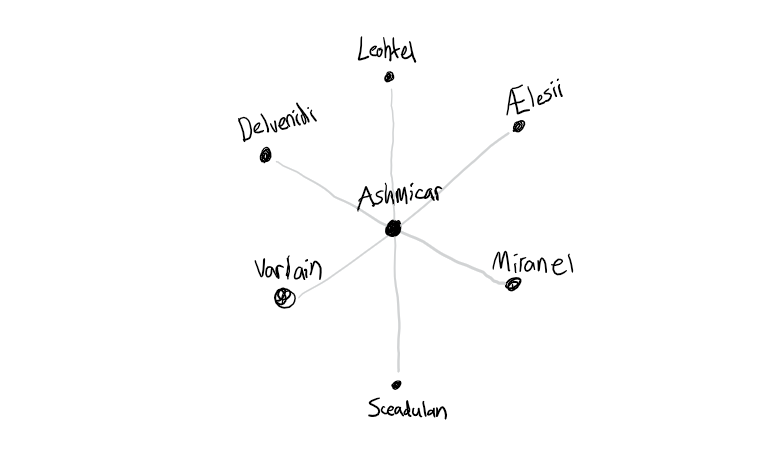
The seven do not have clear portfolios. Instead, they were a ruling council that collectively made rulings on the world, though each had their directional and attitudinal opposite, with the exception of Ashmicar, mediator and center realm. Their realms are depicted as a circle. Starting at the top, the realms were the realm of Leohtel, Ælesii (Alesii), Miranel, Sceadulan (Shadulan), Varlain, and Delvenidi.
The Weavers
The Weavers are the orc gods. They worked together to map the way the world worked and then wove events into being as they were happening—not creating or causing things to happen and not observing them, but predicting so perfectly that they still documented a correct history of the Isles. These gods are Adneri the Scribe, who researches and studies the changes taking place that inform the predictions and spins the thread to be woven in; Karnus the Weaver, who weaves according to the instructions of Adneri and maintains the smooth flow of what happens in the world; and Lasva the Mender, the child-god who played at the feet of her mothers until the tapestry was shredded in the cosmic shift known as the Breaking and who now works to restore the tapestry to the state it was in before it was destroyed.
Underdark Gods
There is no worship of the Divine Cycle in the underdark, and Myth worship is not called that by name. Most in the underdark follow the religion of others of their race and have a different framing of Myths.
Mycelial Network
The myconids—the dominant force in the underdark—thrive off the dense ambient magic that permeates the tunnels and caverns of the underdark. Their mycelial network connects each myconid to the others, giving them a sense and reality of unity. While the myconids are not a full hivemind, they have a sort of collective consciousness and constant connection. The myconids view the ambient magic that they feed on as the source of their one-ness and worship it and the continual existence it brings them. It is the Lifeblood—Pilafala—that runs under the surface of the world.
Myconids are expansionist. They are conquerers. They rot the stone of the underdark and the bodies of any who are not yet a part of their holy unity, their divine network. Their goal is to grow their colony and bring others in as part of them. Myconids also seek to retain their dead and to feed on them in a perpetual cycle of existence—there is no destruction, only repurposing and remixing.
Cave Mother
The duergar and svirfneblin both worship the same deity—the Cave Mother who protects them from whatever they fled from when they first came to the underdark in a time before memory. They are monotheistic, only worshipping her, though duergar are somewhat monolatrous, believing the existence of other gods but not worshipping or venerating them in any way.
To the duergar, the Cave Mother is the one god who protected them when all other gods abandoned them. They fled underground as refugees from a divine disaster, and as such they find protection in her. Duergar do not put stock in any of the gods of others, and instead turn to the Cave Mother to protect them from even those other gods.
To the svirfneblin, the Cave Mother is protection from the overwhelming light and noise from outside their caverns. This light and noise is a corrupting influence, and the Cave Mother provides a shelter that hides them from that influence.
The Many Voices of the Void
Drow do not have anything they can neatly categorise as a god. Instead, the drow worship nothing. A cave is a hole. A hole is a thing that exists when something else is removed. And so, a cave is nothing. The drow worship this concept of nothing as a thing, absence as a thing, the removal of something making another thing. A thing that is defined by the absence of another thing. This is a divine force to them, called the Void. The Void is everywhere and has different forms, which they call the Many Voices of the Void. Silence, darkness, caverns, forgetting. This culminates in death—an absence of life and presence—and a cessation of existence, which is an incredibly meaningful thing to the drow. In death, they put off their name and become nothing, joining the void.